
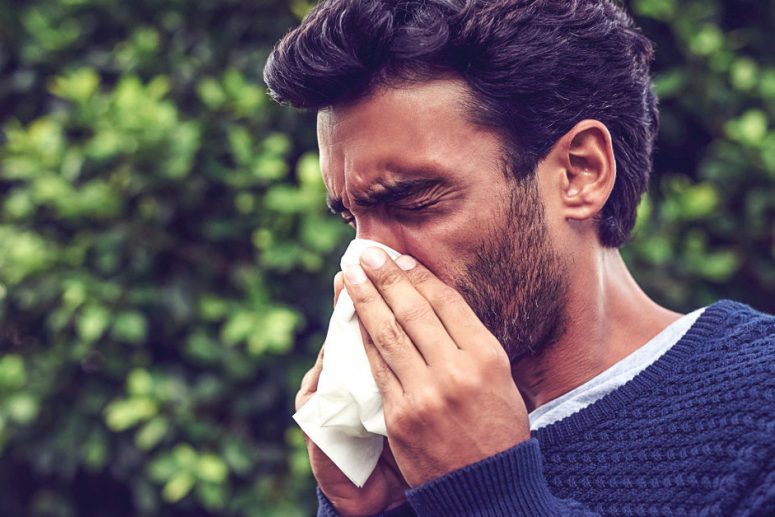
Welcome!
The purpose of this course is to educate pharmacy assistants on how to assist customers with managing allergic rhinitis.
This course is part of the Pharmacy Health Solutions suite of online courses, designed to help pharmacies to maximise the Pharmacy Medicines and Pharmacist Only medicines category and implement professional services to achieve better health outcomes for the customer and a greater return for the pharmacy
Completing this course:
This course will take approximately 60 minutes to complete. Your progress will be bookmarked so you can close the course at any time. When you open the course you will be returned to the same place.
The learning objectives for this course are:
- Outline the nature of allergic rhinitis and its causes.
- Describe the lifestyle management approaches for the treatment of allergic rhinitis.
- Describe the key points of advice that should be provided to customers requesting common treatments for allergic rhinitis.
- Identify which customers should be referred to the pharmacist and how best to do so.
- Describe the key points of advice that should be provided to customers requesting Flixonase® as a Pharmacy Medicine.
At the conclusion of the course there is an 8 question assessment which will check your learning.
References:
- Access Economics for the Australasian Society of Clinical Immunology and Allergy. The economic impact of allergic disease in Australia: not to be sneezed at. 13 November 2007. Available at www.allergy.org.au/ascia-reports/economic-impact-of-allergies.
- Antihistamines. 2016. In: Australian Medicines Handbook 2016 [Internet]. Adelaide: Australian Medicines Handbook Pty Ltd. 2016 Jul. Available from: https://amhonline.amh.net.au/chapters/chap-01/antihistamines-01.
- Australasian Society of Clinical Immunology and Allergy. Allergen minimisation: information for patients, consumers and carers. In: Allergy ASoCIa, editor. Balgowlah, NSW: Australasian Society of Clinical Immunology and Allergy; 2016.
- Australasian Society of Clinical Immunology and Allergy. Pollen allergy [Internet]. Sydney: Australasian Society of Clinical Immunology and Allergy; 2015 [updated June]. Available from: http://www.allergy.org.au/images/pcc/ASCIA_PCC_Pollen_allergy_2015.pdf.
- Australian Institute of Health and Welfare. Allergic rhinitis ('hay fever') in Australia. Cat. no. ACM23 ed. Canberra: Australian Institute of Health and Welfare; 2011 Nov.
- Australian Medicines Handbook [Internet]. Adelaide: Australian Medicines Handbook Pty Ltd; 2016. Available from: https://amhonline.amh.net.au/.
- Bachert C et al. Allergy 1999;54(Suppl 57):116–23.
- Bousquet J, Khaltaev N, Cruz AA, Denburg J, Fokkens WJ, Togias A, et al. Allergic Rhinitis and its Impact on Asthma (ARIA) 2008 update (in collaboration with the World Health Organization, GA(2)LEN and AllerGen). Allergy. 2008;63 Suppl 86:8-160. doi: 10.1111/j.1398-9995.2007.01620.x. PubMed PMID: 18331513.
- Corren J. J Allergy Clin Immunol 1999;104:S144–9.
- Derendorf H et al. Allergy 2008;63:1292–300.
- Flixonase CMI- http://www.medsafe.govt.nz/consumers/cmi/f/Flixonase.pdf
- Flixonase Pack Information.
- Gehanno P et al. Allergy 1997;52:445–50.
- Greiner AN, Hellings PW, Rotiroti G, Scadding GK. Allergic rhinitis. Lancet. 2011;378(9809):2112-22. Epub 2011/07/26. doi: 10.1016/s0140-6736(11)60130-x. PubMed PMID: 21783242.
- Meltzer EO et al. Ann Allergy Asthma Immunol 2001;86:286–91.
- MIMS Online [Internet]. St Leonards, NSW: MIMS Australia Pty Ltd.; 2016. Available from: https://www.mimsonline.com.au/.
- Nathan RA. Clin Ther 2008;30:573–86.
- Rhinitis and rhinosinusitis. 2015 Mar. In: eTG complete [Internet]. Melbourne: Therapeutic Guidelines Ltd. March 2015. Available from: https://tgldcdp.tg.org.au/viewTopic?topicfile=rhinitis-rhinosinusitis.
- Rutter, Paul, & Newby, David. (2016). Community Pharmacy : Symptoms, Diagnosis and Treatment (3rd Edition). Pp 25-36. Chatswood, NSW, AUS: Elsevier Health Sciences.
- Trangsrud AJ et al. Pharmacotherapy 2002;22:1458–67.
- Wiseman LR et al. Drugs 1997;53:885–907.
- World Allergy Organization. WAO white book on allergy: Update 2013. Milwaukee: World Allergy Organization; 2013.pg 7 and pg 107


 We are permitted to dispatch pharmaceutical products only within Australia.